

-
 Sale
Was: $79.99Now: $65.99
Sale
Was: $79.99Now: $65.99 -
Sale
Was: $134.99Now: $116.99
-
Sale
$82.99 - $122.98
-
Sale
Was: $85.99Now: $81.99
-
Sale
Was: $476.99Now: $350.99
-
Sale
Was: $468.99Now: $445.99
-
$29.99

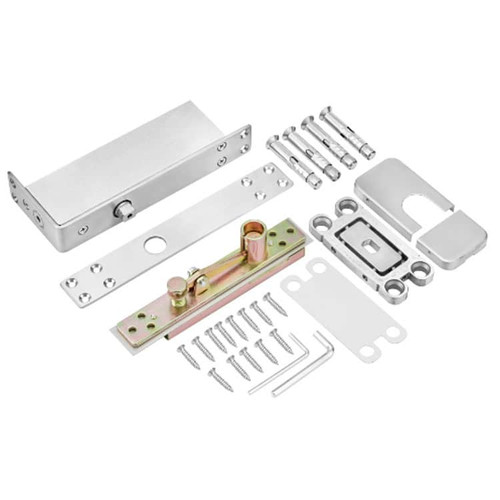
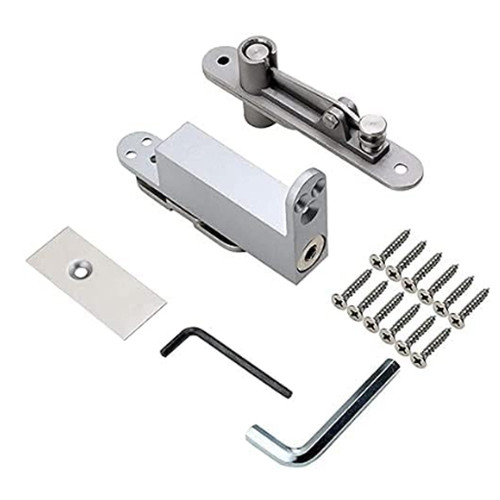


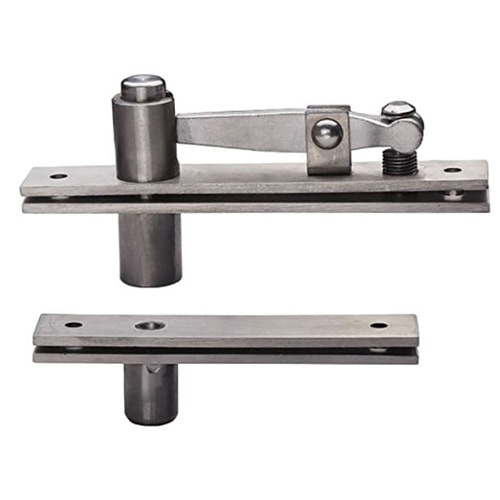

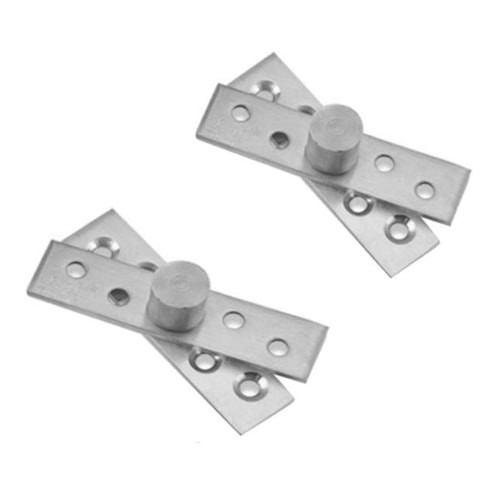


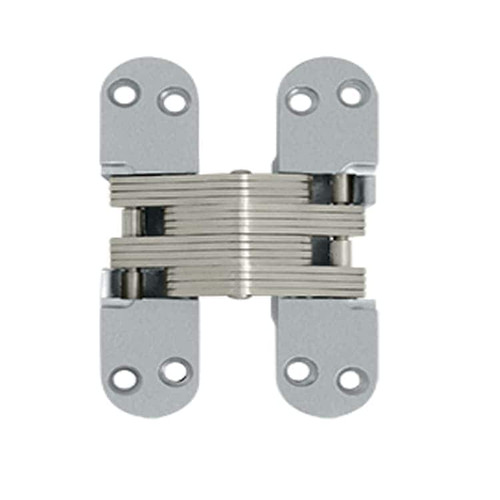


Hidden Hinges for Secret Doors & Hidden Rooms
The most demanding application for concealed door hinges is a true hidden door — a door disguised as a wall panel, bookcase, or room feature where no hardware should be visible from the outside.
- Load capacity: 88–500 lbs per pair/hinge
- Swing range: Up to 180° or 360° with pivot hinge systems
- Three-axis adjustability for precise alignment
- Durable stainless steel and zinc alloy construction
Hidden Door Hinges for Interior Doors & General Applications
Hidden hinges are also widely used in standard interior applications where a clean look is desired. Commonly paired with pantry doors and modern interiors, they eliminate visible hardware while maintaining performance.
Hidden Bookcase Door Hinges
Our bookcase door hinges and bookshelf hidden door hardware are specifically designed for heavy-duty concealed door applications. For most residential bookcase door builds:
- Weight: A fully stocked bookcase can approach or exceed 150–400 lbs. Use our heaviest-duty concealed hinge pairs and confirm the load rating covers the loaded (not empty) weight of the bookcase.
- Outswing configurations: Most bookcase doors are outswing — opening away from the room — which requires specific hinge geometry. See the outswing section below.
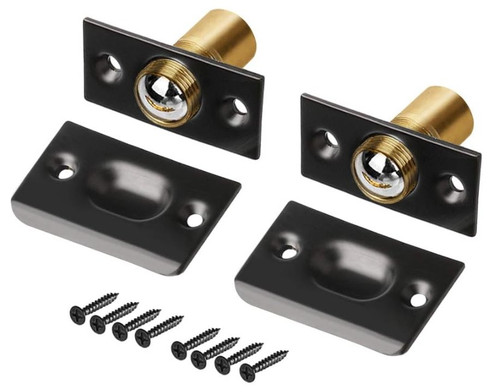
We also carry additional hardware for secret bookcase door builds including latches, catches, and pull hardware that can be integrated into the bookcase design without breaking the concealment.
Bookcase doors require higher load capacity and additional hinges due to weight. For alternative high-traffic hinge systems, explore our cafe door hinge hardware.
Hidden Door Hinges for Outswing Doors
Outswing hidden door configurations — where the door swings outward, away from the room it's protecting — are one of the more technically specific applications for concealed hinges. Standard hinges are designed for inswing doors; outswing requires a different hinge geometry to maintain the concealed profile when the door is in the closed position.
Our hidden door hinges outswing models are designed specifically for this. Key considerations:
- Hinge geometry: Outswing concealed hinges need a longer throw arm than inswing models to clear the frame on the outside swing.
- Reveal consistency: Three-axis adjustment is especially important on outswing doors because the tolerances are tighter — small misalignments are more visible on an outswing configuration.
- Bookcase outswing: Most bookcase hidden doors are outswing by necessity; the same hinge applies, but confirm the load rating includes the stocked weight.
If you're unsure whether your build is inswing or outswing, the rule is simple: if the door opens toward you when you're standing in front of it (outside the room), it's an outswing.
Hidden Door Hinges vs Cabinet Hinges
Cabinet hinges are designed for lightweight applications (20-100 lbs), while hidden door hinges are built for full door weight and structural performance up to 500 lbs.
Concealed Hinges — What Makes Ours Different
Concealed door hinges are a category, not a single product. The term covers everything from lightweight euro-style cabinet hinges to heavy-duty commercial pivot mechanisms. Our concealed hinges are built specifically for full door applications — not cabinet overlays.
What distinguishes a door-rated concealed hinge from a cabinet concealed hinge:
- Load rating: Cabinet concealed hinges typically support 20–40 lbs per pair. Our door-rated concealed hinges support 88–275 lbs per pair depending on configuration.
- Mortise depth: Door-rated concealed hinges require routing into the door edge and frame, not just a surface cup hole.
- Swing arc: Cabinet hinges typically swing 100–110°, while door-rated concealed hinges can reach 180°, with pivot-style hinges allowing up to 360° rotation.
If you're searching for concealed hinges for a standard cabinet door, our hinges are likely overbuilt for that application. If you're hinging a full door — even a lighter interior door — a door-rated concealed hinge is the correct specification.
Installation Overview
Hidden door hinges require routing into both the door edge and the frame — this is not a surface-mount installation. The basic process includes the following steps:
- Mark hinge positions on the door edge — top, bottom, and center minimum. Add a fourth hinge for doors over 80 inches or loads exceeding 150 lbs.
- Rout mortises using the included template. Standard cup diameter is 35mm with a depth of 13–15mm. Frame mortise dimensions will vary depending on the hinge model.
- Dry-fit and test the swing before final fastening. Check for consistent reveal gaps and smooth operation throughout the full swing arc.
- Fasten and adjust. Use #8 screws for wood frames, shim if mounting surfaces are not flush, and fine-tune all three adjustment axes to achieve even reveals.
For outswing doors and bookcase applications, we recommend dry-fitting the door fully loaded before final installation. The added weight can affect sag and reveal consistency, so testing under real conditions is important.
Tools required: Drill press or handheld drill, 35mm Forstner bit or hinge cup bit, router with edge guide, level, measuring tape, and the included installation template.
Related Door Applications
- Swinging Cafe Doors — Two-way traffic doors
- Cafe Door Hinges — Double-action hinge systems
Frequently Asked Questions
What is a hidden door hinge?
A hidden door hinge is a concealed hinge installed inside the door and frame, leaving no visible hardware when the door is closed.
Are concealed hinges and hidden hinges the same?
Yes. The terms concealed hinges, hidden hinges, and invisible hinges are often used interchangeably, although concealed hinges may also refer to cabinet hardware in some applications.
Can hidden hinges support heavy doors?
Yes. Depending on the model and configuration, hidden door hinges can support doors rated up to 275 lbs per pair, making them suitable for many interior doors, hidden doors, and bookcase door applications.
Do hidden hinges work for cabinet doors?
They can, but they are typically overbuilt for cabinet applications and require deeper mortising than a standard cabinet hinge.
Can they be used for pantry doors?
Yes. Hidden hinges are commonly used with pantry doors when a clean, modern look is desired.