


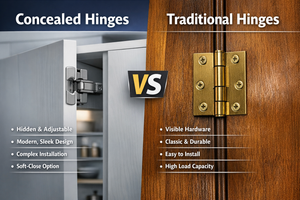
Concealed Hinges vs. Traditional Hinges: Understanding the Key Differences
Concealed Hinges vs. Traditional Hinges: Understanding the Key Differences
Choosing the right hinge may not be the first thing that comes to mind during a renovation or build, but it plays a major role in functionality, durability, and design. Hinges determine how a door swings, how much weight it can bear, and how clean or seamless a finished look appears. Among the broad range of hinge styles, two categories dominate most residential and commercial applications: concealed hinges and traditional hinges.
While both hinge types serve the same basic purpose—allowing a door to pivot—each brings its own strengths, limitations, and design implications. In this comprehensive guide, we’ll break down the core differences, when to use each type, and what to consider before choosing the right hinge for your project.
What Are Concealed Hinges?
Concealed hinges, sometimes referred to as hidden, European, or invisible hinges, are installed inside the door and frame, making them completely hidden when the door is closed. Known for their sleek, modern appearance, these hinges are widely used in contemporary cabinetry, flush doors, minimalist interiors, and spaces striving for a clean architectural look.
Key Features of Concealed Hinges
-
Invisible when door is closed
-
Multi-dimensional adjustability (height, depth, and side-to-side)
-
Modern, seamless aesthetic
-
Designed for flush or full-overlay doors
-
Often used in high-end cabinetry, wall panels, hidden doors, and premium interior design applications
What Are Traditional Hinges?
Traditional hinges refer to visible hinge styles such as butt hinges, strap hinges, piano hinges, and surface-mounted hinges. These hinges have been used for centuries and remain a durable, dependable option across countless door types—from residential entry doors to cabinets, gates, and commercial doorways.
Key Features of Traditional Hinges
-
Visible hardware when the door is closed
-
Simple installation with common tools
-
High durability and load capacity
-
Suitable for interior and exterior doors
-
Available in many decorative finishes and styles
Comparing Concealed Hinges vs. Traditional Hinges
To choose between concealed and traditional hinges, it’s important to consider aesthetics, installation requirements, adjustability, durability, cost, and long-term maintenance.
1. Aesthetics and Design Impact
Concealed Hinges
Concealed hinges offer a clean, uninterrupted look. When the door is closed, no hardware is visible—ideal for modern, minimalist design. This is especially popular in:
-
Contemporary kitchens
-
Closet systems
-
Cabinetry
-
Secret or hidden doors
-
Wall paneling
This hinge style supports design concepts where lines are clean and architectural elements are visually quiet.
Traditional Hinges
Traditional hinges are visible and contribute to the overall door style. They can be purely functional or highly decorative, depending on the hinge type and finish.
Common decorative finishes include:
-
Oil-rubbed bronze
-
Polished nickel
-
Satin brass
-
Matte black
-
Antique pewter
In classic, rustic, farmhouse, industrial, or transitional interiors, visible hinges help define the style.
Bottom Line:
-
Choose concealed hinges for seamless modern aesthetics
-
Choose traditional hinges when decoration, authenticity, or visible hardware is part of the design
2. Installation Requirements
Concealed Hinges
Installing concealed hinges is more complex. Most require:
-
Precise boring (often 35mm for European hinges)
-
Mortising into both door and frame
-
Accurate alignment for smooth operation
This often necessitates specialized tools or professional installation.
Traditional Hinges
Traditional hinges are much simpler to install:
-
Typically require shallow mortises or can be surface-mounted
-
Most can be installed with basic tools (chisel, drill, screwdriver)
-
Alignment is straightforward
This makes them ideal for DIYers or quick replacements.
Bottom Line:
-
Concealed hinges require skill and precision
-
Traditional hinges are easier to install and adjust
3. Adjustability and Alignment
Concealed Hinges
One of the biggest advantages of concealed hinges is their multi-axis adjustability. Most allow:
-
Vertical adjustments
-
Horizontal adjustments
-
Depth adjustments
This makes fine-tuning easier, especially in modern cabinetry or frameless door systems.
Traditional Hinges
Most traditional hinges have limited adjustability. To correct alignment, you typically need to:
-
Loosen screws
-
Reposition the hinge
-
Add shims
-
Plane the door
Corrections are more time-consuming.
Bottom Line:
-
Concealed hinges offer superior, built-in adjustment
-
Traditional hinges require manual correction
4. Durability and Load Capacity
Concealed Hinges
High-quality concealed hinges are engineered for smooth, durable function, but:
-
They often have lower load capacity compared to heavy-duty butt hinges
-
They can wear faster under high-frequency or heavy doors
-
Some models include soft-close mechanisms, which add complexity
Concealed hinges are best for interior doors, cabinetry, and lighter or medium doors.
Traditional Hinges
Traditional hinges are known for:
-
Exceptional strength
-
Ability to support heavy doors, including exterior or commercial doors
-
Simple mechanical design that lasts decades
Heavy-duty butt hinges, ball-bearing hinges, and piano hinges outperform concealed hinges in load-bearing applications.
Bottom Line:
-
Concealed hinges are durable but best for lighter, interior doors
-
Traditional hinges excel in strength, longevity, and heavy loads
5. Maintenance and Repair
Concealed Hinges
Pros:
-
Minimal dust and grime since they are enclosed
Cons:
-
Harder to access
-
Replacements must match exact model and geometry
-
Soft-close mechanisms can fail
Traditional Hinges
Pros:
-
Easy to clean, oil, and maintain
-
Universal sizing makes replacements straightforward
-
Visible hardware simplifies inspection
Cons:
-
More visible wear over time
Bottom Line:
-
Concealed hinges require more specialized maintenance
-
Traditional hinges are easy to repair and replace
6. Cost Considerations
Concealed Hinges
-
Usually more expensive per hinge
-
Installation increases overall cost
-
Best for premium or custom applications
Traditional Hinges
-
Typically more affordable
-
Lower installation costs
-
Widely available and compatible with most doors
Bottom Line:
-
Concealed hinges are a premium option
-
Traditional hinges are budget-friendly and versatile
When to Use Concealed Hinges
Choose concealed hinges if your project demands:
-
A modern or minimalist design
-
A hidden or secret door system
-
Cabinetry with flush or overlay doors
-
Adjustable alignment for a clean finish
-
Sleek, uninterrupted surfaces
Ideal applications include:
-
Contemporary kitchens
-
Custom closet systems
-
Flush interior doors
-
Wall paneling
-
Hidden pantry doors
When to Use Traditional Hinges
Choose traditional hinges when you need:
-
High durability
-
Heavy load capacity
-
An architectural or decorative hardware look
-
A simple, cost-effective installation
-
Exterior or high-traffic door hardware
Ideal applications include:
-
Entry doors
-
Bedroom and bathroom doors
-
Gates and exterior structures
-
Rustic, farmhouse, or vintage interiors
-
Commercial and institutional doors
| Feature | Concealed Hinges | Traditional Hinges |
|---|---|---|
| Visibility | Completely hidden when door is closed | Visible when door is closed |
| Aesthetic Style | Modern, minimalist, seamless appearance | Classic, decorative, industrial, or architectural |
| Installation Complexity | Requires precise boring or mortising; often professional installation | Simple mortise or surface-mount installation; DIY-friendly |
| Adjustability | Multi-directional adjustment (height, depth, side-to-side) | Limited adjustability; requires manual repositioning or shimming |
| Load Capacity | Moderate; best for interior and lighter doors | High; suitable for heavy residential and commercial doors |
| Durability | Durable but includes more moving components | Extremely durable with simple mechanical design |
| Maintenance | Harder to access; model-specific replacement | Easy to inspect, lubricate, and replace |
| Soft-Close Option | Often available (especially cabinet hinges) | Not built-in; requires separate hardware |
| Cost | Higher hardware and installation cost | Generally more affordable |
| Best Applications | Modern interiors, cabinetry, flush doors, hidden doors | Entry doors, bedroom doors, gates, commercial doors |
Frequently Asked Questions
1. Are concealed hinges stronger than traditional hinges?
Not usually. Traditional butt hinges—especially ball-bearing versions—tend to support heavier doors. Concealed hinges are best suited for medium-weight or interior applications.
2. Can concealed hinges be used on solid wood doors?
Yes, but the door must be properly prepared, and the hinge must be rated for the door’s weight. Overloading can reduce hinge lifespan.
3. Are concealed hinges harder to install?
Yes. They often require precise drilling or mortising. Traditional hinges are typically easier for DIY installation.
4. Do concealed hinges offer soft-close functionality?
Many do, especially European cabinet hinges. Traditional butt hinges do not offer soft-close capability unless paired with a separate device.
5. Are traditional hinges outdated?
Not at all. Traditional hinges remain essential for high-strength applications and are available in countless modern and decorative finishes.
6. Which hinge style is best for hidden or secret doors?
Concealed hinges—especially SOSS-style or invisible hinges—are ideal for hidden doors because they create a flush, uninterrupted surface.
7. What finish options exist for traditional hinges?
Finishes include matte black, brass, nickel, chrome, bronze, stainless steel, antique brass, and many more.